
Когда на сайт пытается попасть человек, а вместо искомого контента натыкается на ошибку, то важно выяснить, что это за ошибка и почему она посмела явиться в столь неподходящий (а это любой) момент.
Благо у нас есть замечательные коды 4хх и 5хх, хоть и не так подробно, как хотелось бы, но рассказывающие о том, почему возникла ошибка. Ну а мы, зная эту информацию, можем попытаться ошибку исправить.
В этом материале речь пойдет об ошибке 405 Method Not Allowed. В деталях опишу проблему и расскажу, как ее побороть.
Что означает код ошибки сервера 405?
Код 405 Method Not Allowed говорит нам о том, что сервер получил определенный запрос с заданным HTTP-методом, смог его распознать, но не дает добро на его реализацию. То есть пользователь не получит доступ к контенту, который запросил.
В отличие от 404, 405 уточняет, что запрашиваемая страница существует и функционирует. Только вот стоит изменить используемый в HTTP-запросе метод. Иначе ничего не выйдет.
Комьюнити теперь в Телеграм
Подпишитесь и будьте в курсе последних IT-новостей
Подписаться
Из-за чего я вижу эту ошибку?
Есть 9 HTTP-методов, которые используются браузерами для общения с серверами. Из них два задействуются чаще остальных. Это метод GET для запроса информации с ресурса и метод POST для передачи какой-нибудь информации на ресурс. Два метода покрывают почти все существующие сценарии взаимодействия клиента и сервера от запроса статьи до отправки логина и пароля на сайт. Так как они выполняют разные задачи, для сервера нет никакой нужды принимать GET для авторизации на сайте или POST для загрузки данных. Если же клиент так делает и отправляет некорректный запрос (не с тем методом, который должен быть), то сервер ответит ему ошибкой. То же произойдет, если ресурс будет настроен так, что не сможет принимать специфичный набор запросов, не попадающих в «стандарт». Такие дела.
Как исправить 405 Method Not Allowed?
Ок, небольшой ликбез провел, теперь расскажу о том, что можно предпринять, чтобы исправить обнаруженную ошибку и вернуть посетителям доступ к сайту.
Что может сделать пользователь?
Ошибка Method Not Allowed под номером 4хх вроде бы говорит о вине клиента. Но несмотря на это, пользователь мало что может сделать, чтобы устранить проблему. В его компетенции только убедиться в том, что он не допустил ошибку в базовых вещах, и попробовать повторить те же действия в надежде на успех.
Заново открыть ту же страницу
Иногда 405 Method Not Allowed может исчезнуть после перезагрузки страницы. Так что перед тем как принимать сложные решения и жаловаться на владельцев сайта, нажмите F5 или Cmd + R раза два.
Проверить, правильно ли он ввел URL-адрес
Несложная задача, но полезная. Как и в случае с кучей других ошибок, 405 может явиться из-за банальной опечатки или лишнего символа. К тому же многие серверы защищены таким образом, чтобы напрочь блокировать доступ к несуществующим страницам или каким-либо подуровням (в которые человек может пытаться залезть неслучайно).
Так что пользователю стоит заглянуть в адресную строку браузера и убедиться в корректности введенной ссылки. Если что-то нет так, то лучше открыть главную страницу сайта и искать нужную информацию там, а не пытаться попасть на нее, вводя адрес вручную.
Что может сделать владелец сайта?
Как это часто бывает, у сервера гораздо больше способов исправить клиентскую ошибку. Тут реально целый ворох решений: от удаления подозрительных компонентов из CMS до редактирования конфигурационных файлов.
Проверить настройки сервера
Тут будут инструкции для владельцев сайтов на базе Apache и Nginx в Timeweb. Понятно, что есть другие варианты конфигураций, но эти два — чуть ли стандарт, использующийся повсеместно. А информация, касающаяся конкретно Timeweb, заденет только расположение файлов и работу с панелью управления хостинга. Остальные моменты универсальны.
Инструкция для пользователей Apache
Наша задача состоит в том, чтобы в файле .htaccess найти записи, которые могут провоцировать появление ошибки 405. А потом их закомментировать или удалить. Чтобы это сделать:
- Открываем панель управления Timeweb.
- Ищем внутри вкладку «Файловая система» и переходим на нее.
- Открываем файл .htaccess.
- Внутри .htaccess ищем директивы Rewrite… (обычно это RewriteEngine, RewriteCond и RewriteRule).
Эти директивы помогают в настройке переадресации и некоторых других аспектах поведения сервера. Например, чтобы заставить сервер отправлять клиенту ошибку на каждый запрос GET, можно ввести такой код:
RewriteEngine on
RewriteCond %{REQUEST_URI} ^/ru/services/?.$
RewriteCond %{REQUEST_METHOD} =GET
RewriteRule ^(.)$ http://timeweb/ru/new$1 [R=405,L]
За появление ошибки отвечает запись [R=405,L]. То есть в настройках указано, как себя будет вести сервер при определенном запросе. Надо найти все такие директивы и закомментировать их, поставив # перед записью.
Инструкция для пользователей Nginx
Здесь нужно сделать примерно то же. Разница в том, как выглядит файл с настройками и в его расположении.
- Ищем файл nginx.conf по пути /usr/local/nginx/conf или /usr/local/etc/nginx.
- Открываем его любым текстовым редактором.
- Находим код, включающий в себя упоминание ошибки 405.
В Nginx код выглядит немного сложнее. Например, запрос метода для ссылки https://moysait.com/ru/services/create будет выглядеть так:
server { listen 80; listen 443 ssl;

server_name moysait.com;

location /users/create { if ($request_method = POST) { return 405 https://moysait.com/services/create$request_uri; } } }
Делаем ту же процедуру. Останавливаемся везде, где находим директиву с ошибкой 405. Анализируем ее (вдруг, она тут случайно). И при необходимости комментируем или удаляем.
Исправить проблемы, связанные с PHP-скриптами
Ошибки могут возникнуть при попытке импортировать или экспортировать слишком объемную базу данных. На хостинге может быть установлено ограничение в полминуты, запрещающее использовать один PHP-скрипт дольше этого времени. Поэтому, если процесс затянется, сервер может отозваться ошибкой 405.
Обойти ограничение можно тремя путями:
- Попробовать экспортировать БД через phpMyAdmin.
- Разбить файл БД на несколько мелких частей, передача каждого из которых займет меньше 30 секунд.
- Использовать для передачи БД Cron-задачу. На них сервер выделяет больше времени.
Еще специалисты рекомендуют удалить статические файлы с разрешением, которые Nginx обрабатывать не должен. Это делается через панель управления хостингом в соответствующем разделе файлового менеджера.
Исправить эксклюзивные для Nginx ошибки
Как мы уже выяснили выше, ошибка может возникнуть при попытке использовать неподходящий метод. Вот как можно исправить это в случае с Nginx-сервером.
Первый вариант — убедить сервер в том, что вместо кода 405 надо отправлять код 200, и это вполне нормально:
server {
   listen 80;
   server_name localhost;
location / {
   root html;
   index index.html index.htm; }
error_page 404 /404.html;
  error_page 403 /403.html;
error_page 405 =200 $uri;

…

}
Для тех, у кого Nginx-сервер — это proxy, понадобится вот такой код:
error_page 405 =200 @405;

location @405 { root /htdocs; proxy_pass http://localhost:8080; }
Аналогичная ошибка возникает при работе с модулем FastCGI. Из-за него сервер неправильно считывает запросы с методом POST, поэтому необходимо делить параметры и адрес скрипта вот так:
location ~\.php(.*) {
 fastcgi_pass 127.0.0.1:9000;
 fastcgi_split_path_info ^(.+\.php)(.*)$;
 fastcgi_param SCRIPT_FILENAME $document_root$fastcgi_script_name;
 fastcgi_param PATH_INFO $fastcgi_path_info;
 fastcgi_param PATH_TRANSLATED $document_root$fastcgi_path_info;
 include /etc/nginx/fastcgi_params;
}
Далее речь пойдет об общих методах диагностики и исправления ошибок. На крайний случай, если конкретные решения не помогли.
Проанализировать все недавние изменения в коде
Если недавно что-то поменяли, а после этого все сломалось, то надо это «поменяли» рассмотреть подробнее. Провести ручной дебаггинг, если можно это так назвать. Наверняка где-то затесалась несерьезная, но обидная ошибка.
Удалить сторонние дополнения для CMS
Если вы используете условный WordPress, то разного рода ошибки могут подкрасться оттуда, где их не ждешь. Например, после установки нового расширения.
Так что при подозрении на наличие сбойного дополнения, лучше попробовать от него избавиться и посмотреть, что будет. Возможно, ошибка исчезнет.
После этого уже можно будет поискать альтернативное расширение или пообщаться с разработчиками по поводу того, почему вообще возникает сбой.
Главное, не забудьте сделать резервную копию CMS перед тем, как что-то удалять и менять. И продолжайте делать бэкапы после, чтобы всегда можно было восстановить рабочую версию сайта.
Откатиться на более старую версию CMS
Бывает так, что сама CMS несет в себе баги и ошибки. Ну или криво установилась. В таком случае можно восстановиться из старой резервной копии и откатиться на одну или несколько версий в прошлое. Когда все работало без ошибок.
Проверить новые записи в базе данных
Расширения могут вносить изменения в базу данных сайта. Иногда не очень полезные. Надо проверить, не появилось ли после установки свежего дополнения каких-либо непрошенных изменений в базе данных. Может, появились подозрительные записи, которых не должно быть. Лучше подвергнуть анализу всю БД от начала до конца (если другие методы исправления ошибки 405 не помогли, конечно).
На этом будем заканчивать. Мы и так уже перешли на самые маловероятные способы исправления этой ошибки. Надеюсь, они не понадобятся, но знать о таких вариантах стоит. Вдруг эти знания когда-нибудь спасут вас и посетителей вашего сайта.
In this article, we will show you how to send a “405 Method Not Allowed” header using PHP.
The “405” status allows us to tell a client it is using an incorrect HTTP method.
This is an important header to have in your “toolbox” if you want to restrict certain PHP scripts to POST, PUT, or GET requests.
For example, let’s say that we want to restrict a PHP script to POST requests only.
//An array of HTTP methods that
//we want to allow.
$allowedMethods = array(
    'POST'
);

//The current request type.
$requestMethod = strtoupper($_SERVER['REQUEST_METHOD']);


//If the request method isn't in our
//list of allowed methods.
if(!in_array($requestMethod, $allowedMethods)){
    //Send a 405 Method Not Allowed header.
    header($_SERVER["SERVER_PROTOCOL"]." 405 Method Not Allowed", true, 405);
    //Halt the script's execution.
    exit;
}

//This will only be printed out if a
//POST request is used.
echo 'Hello world!';
In the PHP code above:
- We create an array of HTTP methods that we want to allow. In this case, we only want to allow POST requests. If we also want to allow PUT, HEAD and OPTIONS requests, then we can add them to the array as well.
- We retrieve the current request type by accessing the $_SERVER[‘REQUEST_METHOD’] variable.
- After that, we check to see if the current request type is in our array of allowed HTTP methods.
- If the current HTTP method is not present in our $allowedMethods array, we send a “405 Method Not Allowed” response to the client. We do this by using PHP’s header function.
- Finally, we terminate the script.
If you attempt to navigate to this PHP script in your browser, you will see the following:
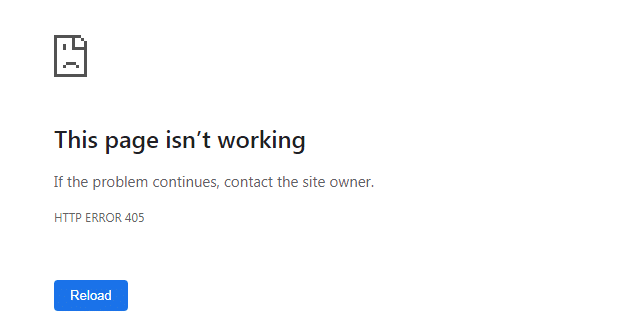
“This page isn’t working.” An example of Chrome returning a 405 error.
This is because your browser sent a GET request to the page when the PHP script only accepts POST requests.
Furthermore, if you inspect the response headers for the request in your browser’s developer tools, you will see something like this:
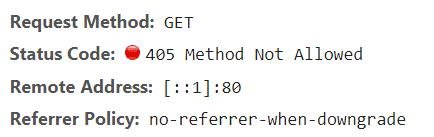
As you can see, our PHP script has returned a “405 Method Not Allowed” status code to the browser.
Using the http_response_code function to send a 405 error.
If you are using PHP version 5.4.0 or above, then you can use the http_response_code function.
This function is a little more concise:
//Send a 405 Method Not Allowed header using http_response_code.
http_response_code(405);
//Kill the script.
exit;
In the example above, we simply replaced the header function with the http_response_code function and passed in 405 as the $response_code parameter.
Related: Blocking POST requests with PHP.
Web servers inform clients, like internet browsers for example, about the processing status of the submitted request with the help of HTTP status codes. So there are various codes that confirm the success or failure of a request – along with very specific messages. While some of these messages are encountered relatively frequently with daily use of the World Wide Web, the 405 (Method Not Allowed) error is one of the more rare error messages. In this article you’ll find out exactly what leads to this error message, and why solving the problem is the responsibility of the website operator.
Contents
- What’s behind the 405 HTTP error?
- When does the 405 error occur?
- HTTP error 405: How to fix the problem
- Solution 1: Enable HTTP methods
- Solution 2: Clean up the source code
- Solution 3: Bypass the provider’s security barrier
$1 Domain Names
Register great TLDs for less than $1 for the first year.
Why wait? Grab your favorite domain name today!
Matching email
SSL certificate
24/7/365 support
What’s behind the 405 HTTP error?
The Hypertext Transfer Protocol (HTTP for short) defines methods that indicate possible actions that can be performed on the contacted web server. For example, this includes the following methods:
- GET: Retrieve information associated with a specific URL resource
- HEAD: Retrieve header information linked with a URL resource
- POST: Send data to the web server – for example, form data
- PUT: Replace the data for a specific URL with new data transmitted by the client
- DELETE: Delete the data behind the respective URL
To display this video, third-party cookies are required. You can access and change your cookie settings here.
The administrator can configure each web server so that the individual methods are either allowed or not allowed. For example, if there’s no interactive content on the website, it’s only logical that the POST method isn’t allowed, since the user has no options to enter their own data and send it to the server. Otherwise, the error message mentioned above with the status code 405 would appear, informing the browser and its user that the method is not allowed.
The exact wording of the 405 HTTP message varies from server to server. Here are some common phrases:
- 405 Method Not Allowed
- 405 Not Allowed
- Method Not Allowed
- HTTP 405 Error
- HTTP Error 405 – Method Not Allowed
- HTTP 405 Method Not Allowed
- Error: 405 Method Not Allowed
- 405 – HTTP verb used to access this page is not allowed
- HTTP Status 405 – HTTP method GET is not supported by this URL
When does the 405 error occur?
We have already indicated that the 405 error is caused solely by a server-side problem. But since status code 405 technically belongs to the client error messages (codes with the pattern 4xx), this doesn’t seem to make sense. This contradiction is quickly solved, though: If, as a browser user, you forward a request to the webserver with an HTTP method that it doesn’t allow due to its configuration, the error lies on the client side from the server’s point of view – in this case, the client simply made a wrong request. The server isn’t aware when processing the request of the fact that you’re only interested in the website’s offer, for example, to fill out a contact form.
Three scenarios in particular can lead to a “Method Not Allowed” error message:
- The ban of the corresponding HTTP method is due to a misconfiguration of web servers or software components that are supposed to perform the respective action for the desired URL resource.
- The ban of the HTTP method is from the website operator – in most cases, for security reasons. The error lies in a URL resource of the web project in question, on the grounds that its programming requires its method to not be allowed.
- The HTTP method is not allowed by the hosting provider of the website operator. This particularly occurs with the POST method, which is required for entering data and is blocked by some providers for security reasons when accessing HTML documents.
HTTP error 405: How to fix the problem
If you come across a web project that displays the 405 Not Allowed error message, you can hardly solve the problem yourself. While with other HTTP messages you can usually solve the problem using tricks like refreshing the page, restarting the router, or checking the proxy settings, these measures are useless against the 405 error. In this case, it makes sense to contact the responsible website operator or administrator to make the problem known or receive exact information about the causes.
If you yourself are responsible for the site that is displaying the 405 HTTP code to visitors, then the circumstances are of course different: Depending on the cause of the error message, you have several options for solving the problem. To avoid angering your users and/or being penalized by search engines, you should resolve the error as quickly as possible.
Solution 1: Enable HTTP methods
If you’re not sure of the cause of the “405 Method Not Allowed” message, you should always first look at the settings of the software components that are responsible for responding to HTTP requests. Typically, this is handled by the web server, but a pre-connected Proxy or HTTP handler (in ASP.NET web applications) could also be responsible for the problem if the method is simply not enabled. Since the different applications differ from each other in terms of configuration, you first have to find out how the activation or deactivation of the HTTP methods functions for each software.
For Apache web servers, enabled methods are specified with the help of the mod_allowmethods module, for example. This can be controlled using the AllowMethods directive in the <Location> containers, which are needed to specify settings for one or more desired URLs. One configuration that enables access to the resource as well as client-side data entry can be implemented with the following entry:
<Location "/">
  AllowMethods GET POST OPTIONS
</Location>
Note
With older Apache versions, permitted HTTP methods are defined with the directives <Limit> and <LimitExcept>
Solution 2: Clean up the source code
If you’ve deliberately blocked an HTTP method, for example, to guarantee the safety of the website (common practice for the PUT method), but the client still triggers such a request to retrieve URL resources, this is often due to incorrect website programming. The requested page or element is therefore incorrectly linked with the method, which is why the 405 error is the logical consequence. The solution is to locate the problematic code in the corresponding HTML document and replace the entered code with the correct request method. If the server configurations and source code are reconciled, then there’s a high possibility that the 405 HTTP error will disappear from the browser window of your visitor.
Solution 3: Bypass the provider’s security barrier
As previously mentioned, the 405 error can also have the background that the corresponding HTTP methods for certain MIME types – like an HTML document, for example – have been disabled by the hosting provider for security reasons. In this case, you can of course contact your provider and ask for approval – but if this isn’t possible, there are tricks that allow you to use the method for your web project anyway.
You can deliver the website with a different MIME type available for the desired method to work around the barrier. POST, for example, is usually deactivated for HTML pages, while the method functions in PHP documents. If you change the extension type, for example, from index.html to index.php, there’s a good chance that you’ll have solved the “405 Method Not Allowed” problem.
To display this video, third-party cookies are required. You can access and change your cookie settings here.
A second trick is to implement the website that causes the HTTP error as the content of the displayed 405 error page. To do this, simply save the page in question in a separate directory and define this in the configuration file as the official 405 error message:
ErrorDocument 405 /PathToFile/example.htmlThis solution does have the disadvantage, though, that all success page accesses for the page are classified and counted as errors, which complicates the statistical analysis.
Related articles
 MichaelJayBerlinShutterstock
403 Forbidden: What does the http status code mean and how do you fix it?
Is your browser displaying an http error 403 instead of the web page you requested? This means that the web server has not granted you access to that page. The reason for this differs from case to case; sometimes the website operator as secured this area from being accessed but sometimes it’s simply a case of adjusting your browser settings. This article outlines the various causes of the http…
403 Forbidden: What does the http status code mean and how do you fix it?
 Roland IJdemaShutterstock
How to fix Error 401 Unauthorized
You’re surfing around on the internet, but instead of getting the desired content you only receive an error message: annoying or even downright frustrating. Especially if you don’t exactly know what the status is supposed to mean. How are you expected to solve the problem, if you don’t know what’s causing it? This also goes for the error 401. Here we explain what the error means and what you can…
How to fix Error 401 Unauthorized
 MichaelJayBerlinShutterstock
HTTP 400: Bad Request explained
Internet users are often confronted with error messages. HTTP status codes can be especially annoying, and even more so if you don’t understand what they mean. The message ‘HTTP 400 – Bad Request’ is a mystery for many internet users, but luckily it can be solved in most cases. We explain what the error message means and how to fix the error.
HTTP 400: Bad Request explained
 RDVectorShutterstock
HTTP 408: how to fix the timeout error
Permanent availability is one of the most important things when it comes to a website. However, even the best technical conditions do not offer a 100% guarantee that a website will constantly run smoothly. Connection errors like HTTP error 408 regularly present websites with minor and major difficulties, especially since the causes are often found on the client side. Our guide looks at the causes…
HTTP 408: how to fix the timeout error
 REDPIXEL.PLShutterstock
GET vs. POST – the two most important HTTP requests compared
The two most common and well-known website HTTP requests are GET and POST. But which request method is better? Learn more about these two HTTP requests and find out which method is the right one for your programming needs.
GET vs. POST – the two most important HTTP requests compared
I have one form in a PHP (5.2.9-1) application that causes IIS (Microsoft-IIS/6.0) to throw the following error when POSTed:
The page you are looking for cannot be displayed because an invalid method (HTTP verb) was used to attempt access.
It’s an HTTP 405 status code. All other forms in the application work, so I believe that the IIS ‘verbs’ setting for PHP pages is correct.
This is a customer’s server, which I have no access to for verifying settings or testing code. All I can do is send the customer replacement files. Other customers on IIS servers have no such issue.
The form is perfectly straightforward:
<form method="post" action="index.php">
    ... fields ...
</form>
What can cause IIS to throw that error on one form only, but work fine on others?

hakre
194k52 gold badges436 silver badges836 bronze badges
asked Sep 9, 2009 at 14:50

I managed to get FTP access to the customer’s server and so was able to track down the problem.
After the form is POSTed, I authenticate the user and then redirect to the main part of the app.
Util::redirect('/apps/content');
The error was occurring not on the posting of the form, but on the redirect immediately following it. For some reason, IIS was continuing to presume the POST method for the redirect, and then objecting to the POST to /apps/content as it’s a directory.
The error message never indicated that it was the following page that was generating the error — thanks Microsoft!
The solution was to add a trailing slash:
Util::redirect('/apps/content/');
IIS could then resolve the redirect to a default document as is no longer attempting to POST to a directory.
answered Sep 10, 2009 at 9:50
drewmdrewm
2,0031 gold badge17 silver badges22 bronze badges
I am deploying VB6 IIS Applications to my remote dedicated server with 75 folders. The reason I was getting this error is the Default Document was not set on one of the folders, an oversight, so the URL hitting that folder did not know which page to server up, and thus threw the error mentioned in this thread.

Mike G
4,2329 gold badges40 silver badges66 bronze badges
answered Jun 10, 2011 at 10:39

Boyd WhiteBoyd White
711 silver badge1 bronze badge
The acceptable verbs are controlled in web.config (found in the root of the website) in <system.web><httpHandlers> and possibly <webServices><protocols>. Web.config will be accessible to you if it exists. There is also a global server.config which probably won’t. If you can get a look at either of these you may get a clue.
The acceptable verbs can differ with the content types — have you set Content-type headers in your page at all ? (i.e. if your Content-type was application/json then different verbs would be allowed)
answered Sep 9, 2009 at 15:11

AndiihAndiih
12.3k10 gold badges57 silver badges88 bronze badges
2
I don’t know why but its happened when you submit a form inside a page to itself by the POST method.
So change the method="post" to method="get" or remove action="anyThings.any" from your <form> tag.

Mark Ursino
31.2k11 gold badges51 silver badges83 bronze badges
answered Feb 29, 2012 at 19:26

BobbyBobby
291 bronze badge
1
It sounds like the server is having trouble handling POST requests (get and post are verbs). I don’t know, how or why someone would configure a server to ignore post requests, but the only solution would be to fix the server, or change your app to use get requests.
answered Sep 9, 2009 at 14:56
0
We just ran into this same issue. Our Cpanel has expanded from PHP only to PHP and .NET and defaulted to .NET.
Log in to you Cpanel and make sure you don’t have the same issue.
answered Aug 10, 2018 at 18:51

I had this issue with a facebook application that I was developing for a fan page tab. If anyone faces this issue with a facebook application then
1-goto https://developers.facebook.com
2-select the application that you are developing
3-make sure that all the link to your application has tailing slash /
my issue was in the https://developers.facebook.com->Apps->MYAPPNAME->settings->Page Tab->Secure Page Tab URL, Page Tab Edit URL, Page Tab URL
hope this will help
answered Apr 3, 2014 at 9:49

WaqlehWaqleh
9,7718 gold badges65 silver badges103 bronze badges
As drewm himself said this is due to the subsequent redirect after the POST to the script has in fact succeeded. (I might have added this as a comment to his answer but you need 50 reputation to comment and I’m new round here — daft rule IMHO)
BUT it also applies if you’re trying to redirect to a page, not just a directory — at least it did for me. I was trying to redirect to /thankyou.html. What fixes this is using an absolute URL, i.e. http://example.com/thankyou.html
answered Sep 11, 2014 at 8:40

Doug McLeanDoug McLean
1,28912 silver badges26 bronze badges
i had to change my form’s POST to a GET. i was just doing a demo post to an html page, on a test azure site. read this for info: http://support.microsoft.com/kb/942051
answered Feb 25, 2015 at 19:53

An additional possible cause.
My HTML page had these starting tags:
<!DOCTYPE html>
<html xmlns="http://www.w3.org/1999/xhtml">
This was on a page that using the slick jquery slideshow.
I removed the tags and replaced with:
<html>
And everything is working again.
answered Sep 8, 2015 at 16:43

John MJohn M
14.3k29 gold badges91 silver badges143 bronze badges

В этом выпуске: признаки ошибки 405; решения проблемы ошибки 405 в PHP; советы по устранению Error 405. Подробно о проблеме и путях решения.
Появление ошибки 405 следует трактовать, как произведение операции сервером с запретом на определенном этапе ее совершения. Причин ее появления немало и нужно уметь определять ошибку на предмет признаков, хотя и в этом случае есть исключения.
Идентификация проблемы осуществляется с помощью диалогового окна с соответствующей информацией. После сообщения об ошибке, программа прекращает работу. В браузерах подобное известие может преследовать пользователя сразу на нескольких порталах. Чаще всего о признаках проблемы свидетельствует обозначения HTTP 405 и Method Not Allowed. Впрочем, в некоторых случаях владелец устройства не может сразу определить ошибку. К примеру, причин медленной работы операционной системы или слабого реагирования на действия с помощью клавиатуры и компьютерной мыши довольно много. На этом этапе нет отчетливых отличий 405-й ошибки от других сбоев.
Сюда же относятся периодические «зависания», когда компьютер перестает реагировать на любые действия пользователя и останавливает работу всех программ. В случае с отображением упомянутой ошибки в веб-обозревателях, то браузер может делать ложные выводы касательно определения проблемы. Например, нередко случаются ситуации, когда возникает ошибка 404 на нормально функционирующих ресурсах вместо 405. В свою очередь, делать вывод только по предупреждению от браузера не стоит.
Причины возникновения ошибки 405
Одним из самых распространенных источников проблемы является функционирование php-скрипта. Данный инструмент импортирует данные на сайт, но дело в том, что касательно выполнения скрипта существует временное ограничение в 30 секунд. Упомянутая опция устанавливается на хостинге и подобрать оптимальный для себя параметр невозможно. Исходя из этого, формируется и корень ошибки – скрипту недостаточно временных рамок, утвержденных хостингом. В результате этого пользователь может наблюдать ошибку 405. Если проблема возникает из-за приведенной причины, юзеру следует воспользоваться одним из советов.
Советы по решению ошибки 405 в PHP:
- осуществление импорта базы данных с помощью одноименной опции, которую можно найти в подразделе Хостинг в Панели управления;
- детализация файла путем формирования из него нескольких частей, после чего каждую из них передать через скрипт;
- произведение импорта данных при помощи специального инструмента phpmyadmin;
- создание cron-задачи с вводом пути к скрипту. Данная опция позволяет расширить временное ограничение в 10 раз, что в большинстве случаев вполне достаточно для импорта. Функция доступна в подразделе Хостинг, пункт Расписание задач (cron), а нужную информацию следует вводить в поле Задача.
Еще одной распространенной причиной ошибки часто становятся POST-запросы. Сущность проблемы заключается в обработке расширений файлов с помощью инструмента apache. Ряд расширений могут негативно влиять на работу скрипта, поэтому их следует удалить. Внести необходимые изменения нужно в окне Статические файлы. Путь к нему выглядит следующим образом: Хостинг – Мои сайты – Настройка сайта.
Как и во многих других ситуациях, вирусы могут быть причиной возникновения ошибки. Вредоносное программное обеспечение либо повреждает веб-обозреватель, либо полностью захватывает контроль над ним. В дальнейшем браузер может выдавать целый ряд известий о проблемах. Кроме того, удаление или установка системного программного обеспечения может привести к повреждению реестра, который, в свою очередь, инициирует ошибку 405.
Способы устранения: ошибка 405 (Error 405)
Для ликвидации проблемы рекомендуется принятие следующих мер:
- Восстановление записей реестра.
- Запуск сканирования устройство с целью проверки наличия вирусов и вредоносного программного обеспечения.
- Обновление драйверов.
- Применение опции Восстановление системы, чтобы аннулировать последние корректировки.
- Провести все требуемые системой обновления.
- Проверить системные файлы (sfc / scannow).
- Переустановить продукт WOS (Windows Operating System).
- Установить Windows заново.
Одна или несколько из перечисленных операций точно помогут пользователю избавиться от надоедливых уведомлений и запретов. Исходя из упомянутых рекомендаций, можно сделать вывод, что наиболее эффективная профилактика от появления подобных проблем – это поддержка операционной системы в надлежащем функционировании.