
3 532
Обнаружены пропуски воспламенения в 1 цилиндре
Возможные причины появления ошибки в автомобиле BMW:
- Неисправна свеча первого цилиндра
- Обрыв или замыкание проводки катушки зажигания первого цилиндра
- Неисправна катушка зажигания первого цилиндра
- Обрыв или замыкание проводки форсунки первого цилиндра
- Забит или неисправен инжектор первого цилиндра
- Неисправность разъема проводки форсунки первого цилиндра
- Неисправность разъема катушки зажигания первого цилиндра
- Неправильное давление топлива
- Низкая компрессия в 1 цилиндре
- Подсос воздуха впускного коллектора
Код ошибки P0301 означает, что в первом цилиндре двигателя автомобиля БМВ обнаружены пропуски воспламенения зажигания или случайные пропуски. Диагностику лучше проводить в следующий последовательности – проверить на подсос воздуха впускной тракт, следующий шаг это замена свечи зажигания в первом цилиндре. Если проблема не удалось решить этими двумя пунктами, то необходимо провести дополнительную диагностику , которая детально описана здесь.
ВОЗМОЖНЫЕ СИМПТОМЫ ОШИБКИ P0301 БМВ:
- Горит сигнал «CHEK ENGINE»;
- Отсутствие/потеря мощности двигателя;
- Двигатель «трясет». Неровная работа мотора;
- Затруднен запуск двигателя. Особенно холодного.
Описание ошибки P0301 BMW
При возникновении пропуска воспламенения частота вращения двигателя будет колебаться. Если изменения частоты вращения двигателя достаточны, для изменения сигнала датчика положения коленчатого вала (CKP), блок управления двигателем (ECM) определяет ошибку P0301 BMW.
Содержание
- Что означает
- Симптомы
- Причины
- Как механик диагностирует ошибку
- Насколько это серьезно
- Как устранять
- Коды, связанные с этой ошибкой
Что означает
Ошибка P0301 BMW означает, что произошла осечка цилиндра 1, а также обнаружены пропуски зажигания. Эта ошибка связана с работой системы зажигания и может привести к плохой производительности двигателя и ухудшению экономичности топлива.
Симптомы
Симптомы ошибки P0301 BMW могут включать:
- Тряска двигателя при работе на холостом ходу или при ускорении.
- Потеря мощности двигателя.
- Ухудшение экономичности топлива.
- Неустойчивость холостого хода.
- Появление дыма из выхлопной системы.
- Запах горелого топлива.
Причины
Существует несколько причин, почему может возникнуть ошибка P0301 BMW:
- Проблемы с системой зажигания, включая свечи зажигания, катушки зажигания или провода.
- Неисправность датчика положения коленчатого вала.
- Неисправность датчика кислорода.
- Неисправность форсунки топлива.
- Проблемы с механизмом газораспределения, включая распредвал и толкатели.
Как механик диагностирует ошибку
Для диагностики ошибки P0301 BMW механик может выполнить следующие шаги:
- Подключить диагностический сканер к автомобилю, чтобы прочитать коды ошибок и данные датчиков.
- Проверить состояние свечей зажигания, катушек зажигания и проводов.
- Проверить состояние датчика положения коленчатого вала и датчика кислорода.
- Проверить состояние форсунки топлива.
- Проверить состояние механизма газораспределения.
Насколько это серьезно
Ошибка P0301 BMW может привести к плохой производительности двигателя и ухудшению экономичности топлива. Если проблема не будет устранена, она может привести к более серьезным проблемам, таким как поломка двигателя.
Как устранять
Для устранения ошибки P0301 BMW могут потребоваться следующие действия:
- Заменить свечи зажигания, катушки зажигания или провода.
- Заменить датчик положения коленчатого вала или датчик кислорода.
- Очистить или заменить форсунку топлива.
- Заменить механизм газораспределения.
Коды, связанные с этой ошибкой
Коды, связанные с ошибкой P0301 BMW, могут включать:
- P0300: Общая ошибка пропуска зажигания.
- P0302: Ошибка пропуска зажигания в цилиндре 2.
- P0303: Ошибка пропуска зажигания в цилиндре 3.
- P0304: Ошибка пропуска зажигания в цилиндре 4.
Расшифровка ошибки P0301 у BMW: Обнаружен пропуск зажигания в цилиндре №1
Марка:
BMW
Код:
P0301
Определение:
Обнаружен пропуск зажигания в цилиндре №1
Описание:
Двигатель, работающий со скоростью более 400, но менее 6400 об / мин. DME обнаружил пропуск зажигания или неравномерную работу двигателя в двух или более цилиндрах в пределах 200 оборотов коленчатого вала. Скорость двигателя составляет от 480 до 4500 об / мин, изменение нагрузки составляет 0,4 мс при зажигании со скоростью
Причина:
- Утечка воздуха во впускном коллекторе или в системе EGR или DME.
- Основная механическая проблема двигателя.
- Проблема с компонентом подачи топлива (например, загрязненный топливная форсунка загрязнена или заедает)
- Неисправно реле топливного насоса
- Неисправны предохранители катушки зажигания
Опрос: Где ремонтируется Ваш автомобиль? (Кол-во голосов: 2675)
У себя в гараже
У официалов
В гараже у Васи
Чтобы проголосовать, кликните на нужный вариант ответа.Результаты
From english:
Decoding the error P0301 from BMW: Cylinder Number 1 Misfire Detected
Make:
BMW
Code:
P0301
Definition:
Cylinder Number 1 Misfire Detected
Description:
Engine running at an RPM greater than 400 but less than 6400 the DME detected a misfire or uneven engine running in two or more cylinders within 200 crankshaft rotations.Engine speed is between 480 and 4500rpm,load change is 0.4ms at ignition with a spe
Cause:
- Air leak in the intake manifold,or in the EGR or DME system
- Base engine mechanical problem
- Fuel delivery component problem (i. e. ,a contaminated,dirty or sticking fuel injector)
- Fuel pump relay defective
- Ignition coil fuses have failed
Еще ошибки категории
Ошибки автомобилей разных произвродителей
Опрос: Смогли ли диагностировать неисправность? (Кол-во голосов: 445)
Да, лично
Да, с помощью знакомого
Да, у официального дилера
Нет
Чтобы проголосовать, кликните на нужный вариант ответа.Результаты
Расскажите друзьям:
Поставьте рейтинг, для нас это очень важно:
Голосов: 0 чел. Рейтинг: 0 из 5.



P.S. Никто катушки ngk на n13 не пробовал?
P.S.2. контакты своего дилера не дам)
Пробег: 132 000 км
Запчасти
Комментарии
25
Войдите или зарегистрируйтесь, чтобы писать комментарии, задавать вопросы и участвовать в обсуждении.

Я бошь ставил, ништяк за 5к 4шт

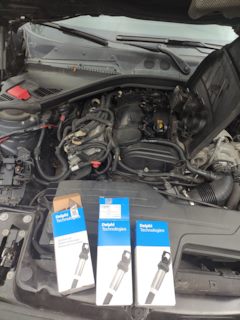
Я в итоге все поставил Delphi т.к. в наличии были, а поездка предстояла более 4000 км на следующий день.
Кавказские горы катать, минералку пить
Планирую через 2 недели в Анапу и Эльбрус поехать
Рекомендую дорогу на Джилы-Су. Предгорье Эльбруса. Шикарную видовую дорогу сделали!
Да в инсте видел, туда хочу, как местные ?
Ровно, спокойно. Никаких эксцессов не было.
Надеюсь через месяц опишу

После двух неудачных замен и выброшенных денег на ветер при покупке Delphi, друг подсказал купить NGK проехал год и очень расстроился что не купил раньше)
Супер, ещё один плюс в их копилку.

а какой номер у NGK ?) надо попробовать )

Delphi отстой)) У самого уже две из тех что менял в прошлом году навернулись (пробег около 5 тыс км всего)
NGK да, вещь!
Супер, тогда на ngk перейду

Ganzales
Delphi отстой)) У самого уже две из тех что менял в прошлом году навернулись (пробег около 5 тыс км всего)
NGK да, вещь!
Я бы такое не писал. У меня они работают до сих пор с 2013 года. Может проблема во все не в них, а как следствие выходят.

Уже около 5 тысяч на катушках нгк)
О! И как себя ведут? Машина прошита?
Ведут хорошо, да, машина шита)
Все комментарии
| Code | Fault Location | Probable Cause |
|---|---|---|
| P0301 | Cylinder 1 -misfire detected (Buy Part On Amazon) |
Engine mechanical fault, wiring, ignition/fuel system, injector, ECT/MAF sensor, ECM |
We recommend Torque Pro
Table of Contents
- What Does Code P0301 Mean?
- Where is the P0301 sensor located?
- What are the common causes of code P0301?
- What are the symptoms of code P0301?
- Get Help with P0301
What Does Code P0301 Mean?
SPECIAL NOTES: Although generic OBD II trouble codes such as P0301 – “Cylinder 1 – misfire detected” can, and do affect all OBD II compliant vehicles, some vehicle makes and models are sometimes more susceptible to some generic trouble codes than most other vehicle makes and models. Under real-world driving and operating conditions, there are several reasons for some generic trouble codes to be more common on some vehicles than on others, but typical reasons include-
- poor part/sensor/component design
- poor routing of electrical wiring
- poor placement of electrical components under seats, carpets, and center consoles
- the exposed location of some parts/sensors/components on some vehicles
- prolonged exposure to contaminants like road salt in some locations that cause damage to some parts and components on some vehicles, but not on others
- difficulty in accessing some parts/sensors/components, thereby preventing or inhibiting the regular inspection, servicing, and/or replacement of affected parts/sensors/components during routine and/or scheduled servicing
- Poor fuel quality in some locations
However, note that not all models of a particular vehicle make will necessarily be equally susceptible to one or more generic trouble codes, because car manufacturers often correct issues like poorly designed parts and/or poor routing of wiring at various points during a model’s production run. Nonetheless, this article will discuss generic trouble code P0301 – “Cylinder 1 – misfire detected” as it applies to the BMW models that are most commonly affected by it. END OF SPECIAL NOTES.
OBD II fault code P0301 is a generic trouble code that is defined as, “P0301 – “Cylinder 1 – misfire detected”, and is set when the PCM (Powertrain Control Module) detects misfires on cylinder#1. Note that on BMW vehicles, the PCM (Powertrain Control Module) is known as the DME (Digital Motor Electronics).
In technical terms, a “misfire” on any given cylinder occurs when the air/fuel mixture in the affected cylinder does not combust, or only combusts partially, thus producing a less torque* than the cylinders in which the combustion process is not affected, inhibited, or prevented from occurring.
*NOTE: Misfires should not be confused with imbalances between cylinder power contributions. However, in practice, and from a diagnostic perspective, it is often difficult to see a difference between misfires and imbalances between cylinder power contributions in terms of causes, symptoms, and effects, since these are often the same in both conditions- although to a lesser degree with cylinder power contributions than with pronounced misfires. To avoid confusion, it is best to think of cylinder power contribution as minor misfires (that set dedicated cylinder power contribution trouble codes), whose effects and symptoms are not as pronounced as those of “real” misfires.
As a practical matter, there are a great many possible faults, defects, and malfunctions that can cause only one cylinder to misfire. Nonetheless, in all cases, a misfiring cylinder causes the rotational speed of the crankshaft to slow down momentarily, and it is this variation in the crankshaft’s speed that the misfire detection system interprets as a misfire. In terms of operating principles, the misfire detection system counts the number of signals the crankshaft position sensor generates as each tooth of the reluctor wheel on the harmonic balancer passes in front of the sensor.
*NOTE: As a general rule, the misfire detection system will only report deviations in the crankshaft’s rotational speed as misfires when the deviation exceeds about 2 percent of the crankshaft’s average speed as measured over one complete engine cycle.
However, in the case of cylinder-specific misfire codes, such as P0301, the misfire detection system correlates the momentary slow-down of the crankshaft with input data from the camshaft position sensor, as well as from feedback circuits in the ignition and fuel delivery systems. This means that during normal operation of the engine, the DME receives input data to confirm that-
- an ignition spark had been delivered to cylinder #1
- that the fuel injector on cylinder #1 had received a signal to open
- that the status of the fuel injector on cylinder #1 had switched from “OFF” to “ON” to “OFF” in response to the signal.
We need not delve into the complexities of ignition timing resolution, or of the driver circuits that control the ignition and fuel delivery strategies to each cylinder here. Nonetheless, suffice to say that by correlating all relevant input data from the-
- Crankshaft position sensor
- Camshaft position sensor(s)
- Ignition feedback circuits
- Fuel injector feedback circuits
- Ignition and fuel injector driver circuits
– the DME, and by extension, the misfire detection system, can relate the momentary reduction in the crankshaft’s rotational speed to a specific cylinder*, which in this case, is cylinder #1.
*NOTE: Depending on the nature of the problem, most misfire detection systems in use today can detect and identify misfires on one or more specific cylinders. In such cases, the last one or two digits in the resulting fault codes will identify the misfiring cylinder. For instance, a misfire on cylinder #6 will have the code P0306; a misfire on cylinder #8 will have the code P0308, while a misfire on cylinder #12 will have the code P0312.
Regardless of which cylinder had been identified as experiencing misfires, all serious misfires have the potential to increase exhaust emissions. Therefore, when the engine management system detects a misfire, it will set the appropriate trouble code, P0301 in this case, and may also illuminate a warning light.
What causes trouble code P0301 to set on BMW applications?
While code P0301 is a generic code that applies to all OBD II compliant vehicles, including BMW vehicles, BMW-specific, and some high-end generic scan tools display code 29CD on E90, E92, E93 models when generic trouble code P0301 is present. This is important because while generic code P0301 identifies the misfiring cylinder, BMW-specific code 29CD identifies the most common cause of the misfire, which is a defective or malfunctioning ignition coil. See the section on “Causes” for details on other possible causes of code P0301 on BMW vehicles.
Where is the P0301 sensor located?

This image shows an example of a damaged exhaust valve on a BMW E92 engine. This is commonly known as a “burnt” valve, and it is fairly common on many BMW engines. See the section on “Causes” for more details.
What are the common causes of code P0301?
Some common causes of code P0301 on BMW applications could include one or more of the following, but note that not all BMW engines are equally susceptible to all, or some of the possible causes listed here-
- Defective or failing ignition coil on cylinder #1
- Defective or failing spark plug on cylinder #1
- Damage to exhaust valves as the result of high combustion temperatures combined with the presence or build-up of carbon deposits on the cylinder head side of the valve seat(s) that prevent efficient and/or equal heat dissipation from the valve seat(s)
- Leak paths in damaged cylinder head gaskets, but note that not all forms of damage to cylinder head gaskets will affect two adjacent cylinders, or cause the engine oil and engine coolant to mix
- Piston ring fractures on cylinder #1
- Defective or broken valve spring on cylinder #1
- Defective or broken valve lifter on cylinder #1
- Defective or broken rocker arm on cylinder #1
- Defective fuel injector on cylinder #1
- Defective fuel injector driver circuit on cylinder #1
- Defective ignition driver circuit on cylinder #1
- Leaking or damaged intake manifold gasket(s) or seals, but note that this is more likely to affect more cylinders than just cylinder #1- it is, however, possible for leaking intake manifold gaskets and/or seals to affect only one cylinder
NOTE: Take note that issues like-
- defective camshaft/crankshaft sensors
- defective, loose, or broken reluctor ring rings/harmonic balancers
- VANOS (variable valve and/or camshaft timing) issues
- serious engine vacuum system leaks
- abnormal fuel pressure
- throttle body, MAF/MAP sensor, and electronic throttle control issues
– will typically affect all cylinders equally, as opposed to affecting only a single cylinder.
What are the symptoms of code P0301?
Common symptoms of code P0301 are largely similar across all BMW applications, and could include one or more of the following-
- Stored trouble code and an illuminated warning light
- Serious power loss will be present at some, or all engine speeds and/or loads, with the degree of power loss, largely depending on the nature of the problem
- The idling quality may be poor
- Fuel consumption may increase noticeably
- Catalytic converter damage and/or failure may occur if the problem persists for an extended period
- If the problem involves defective valve train components, extremely serious (and expensive) damage to the camshaft(s), valves, cylinder heads, and other engine components could result if the problem is not corrected promptly
Help Us Help You
Please comment below describing your issue as well as the specifics of your vehicle (make, model, year, miles, and engine),
and one of our mechanics will respond as soon as possible. We appreciate a $9.99 donation via the payment button below.